"Son, I have one hope and dream for you..."
Young Ralph Hardy looked up at his Dad with wide eyes.
Ralph didn't know what to say. He Dad never spoke to Ralph. The tall father towered over Ralph's short frame--his arm draped loosely over Ralph's small shoulders.
The two stood in the Hardy blacksmith shop, a rough hewn, ramshackle building set far away from the simple ranch house the Family called home.
A large rectangular opening on the southwest wall of the blacksmith shop looked out toward distant Bill Williams Mountain. It was cold that day and a skiff of snow lay upon the land.
The coal fire in the forge warmed Ralph as he shivered beside his Dad. Ralph's Dad had never put his arm around the young boy before and Ralph couldn't remember his Dad ever speaking directly to him. Ralph didn't know what to say, he was tongue-tied.
The Father and Son simply stood there beside the glowing embers of the smithy's fire, staring out the window toward white-topped Bill Williams Mountain.
Ralph's Dad looked down at his Son and slowly repeated himself, ""Son, I have one hope and dream for you..." He let his words sink in on the small boy. Ralph looked up at his Dad, eyes wide with wonder.
"Son, I dream that someday you will earn a dollar a day." Ralph's heart raced and felt like it was going to pound right out of his chest. All he think to do was put his hand up into his Dad's and squeeze. He felt tears begin to well in his eyes and his breath became short.
Ralph himself had never dared to dream he could ever earn a dollar a day. He didn't even know how to imagine what that might mean. A rush of feelings ran willy, nilly through Ralph's spirit and nerves. All he could do was turn to his Father and say, "Thank You, Dad."
And with that, the Old Man turned back to his work at the forge and said nothing again to his son.
As I stood beside Ralph that crisp fall day, tears welled in my eyes, too, as Ralph told his tale with a soft and kind voice. I wanted to burst out crying and hug the little old man but I knew better. Other people nearby might not understand.
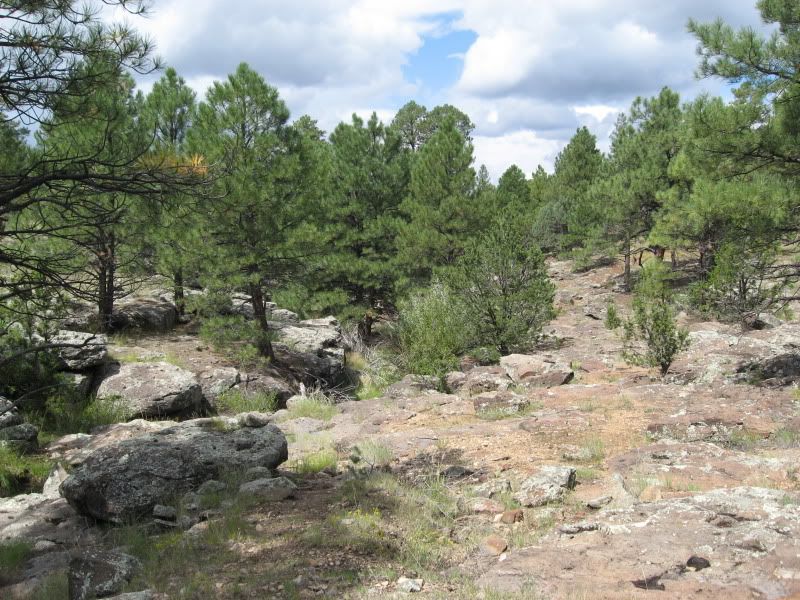
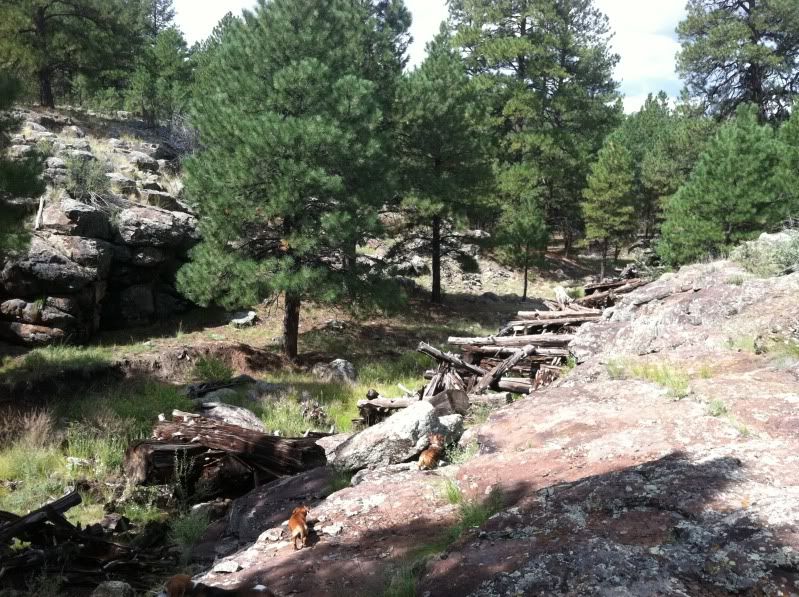
Ralph was standing amid some weather-beaten boards scattered aimlessly across the dusty ground. He had asked me, "John, wold you like to see our old blacksmith shop?" "Sure, Ralph," I replied as we walked around the faint vestiges of his boyhood home in the shadow of Hardy Hill northeast of Williams.
"It was right over here," Ralph pointed. Then he walked around pointing to where the corners of the building had been and how the forge was located and where all the materials were stored. And then Ralph, pointed to the southwest and said, "That's where the big window was located so Dad could look out at the mountain while he did his work.
And Ralph and I stood silent and simply stared out the imaginary window as a slight wind rustled the Northern Arizona landscape.
And as we stood there staring out that big, broad, beautiful window, that's when Ralph began his story. He spoke slowly with no visible emotion. He took a long pause between each of his sentences as if to collect his thoughts.
As Ralph worked his way up to the Dollar-A-Day part, I felt a little dizzy. It was almost as if I was being transported back in time to that very moment in a drafty old building beside a murky stock pond and an old corral made from abandoned railroad ties.
Somehow, my heart could feel Ralph's heart that day and I sensed his spirit had come full circle back to that special spot.
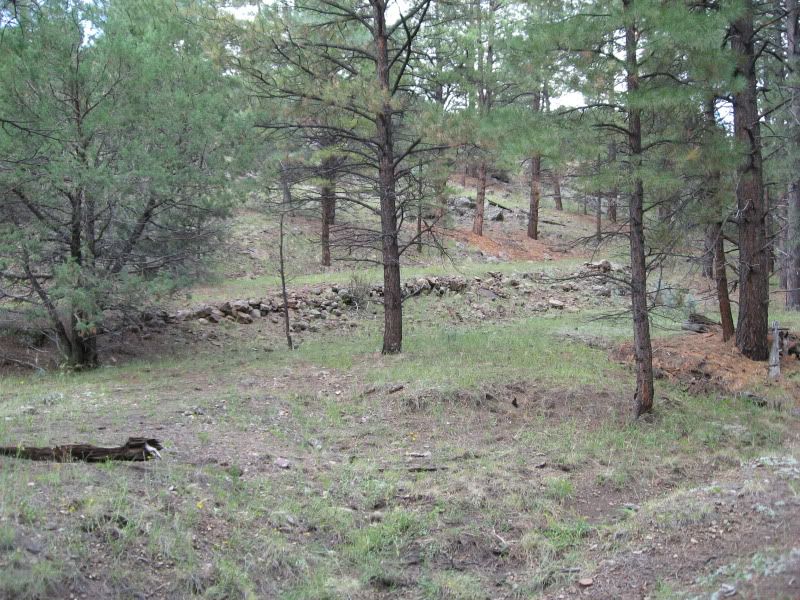
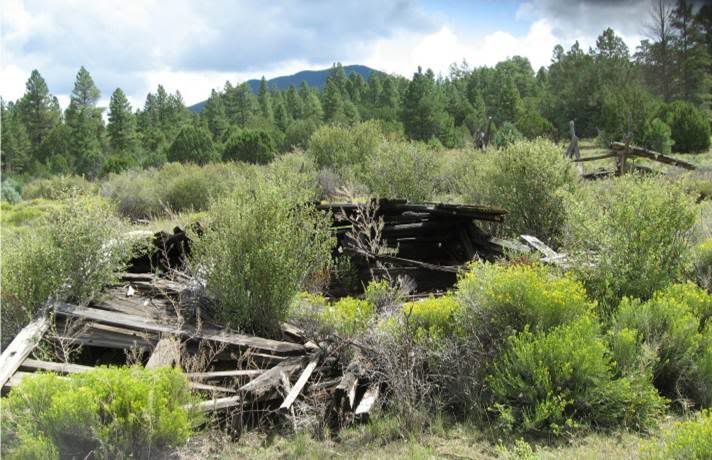
You see, there wasn't anything left of Ralph's boyhood ranch home. Some boards, a few railroad ties, some foundation materials, a dry stock pond and bits and pieces of a life once lived.
Ralph was descending into dementia. He knew he wouldn't be around much longer. So he asked the people he trusted most to take him back to his boyhood home for one last visit. I was put in charge of the Year 2000 excursion. We traveled in a caravan of 3 or 4 vehicles. We enlisted the US NRCS District Conservationist and some of his Staff. We recruited some other Board Members of The Verde Natural Resource Conservation District (NRCD). We even cajoled a videographer to come along to record the trip. It was quite a group.
Ralph held a fine court there that day. He took us all around the ranch as if it was alive and well and fully functioning once again. We learned about his humble room in the small ranch house. We learned how Ralph's Dad used the stock pond to tighten wagon wheel spokes and long-handled tools.
He told us about The Trestle and how it figured in his childhood. We all dutifully trooped over to see the trestle. Ralph regaled us with many a story that day. It was truly his last hurrah.
Not long afterwards, Ralph went into managed care and lived many years in steadily declining health before he passed away in November 2007 at the age of 84.
Ralph lived a full and mostly happy life. I first met Ralph in late 1988 at the very first Board meeting I attended of the Verde NRCD in Cottonwood. Everyone there that evening was cordial and nice but Ralph even more so.
Somehow we bonded almost immediately and I had many enjoyable days with Ralph over the next 10-12 years. He continued to serve on the Verde NRCD Board until he finally went into managed care.
Ralph parents were strict fundamentalists. The Hardy Place prior to moving near Sitgreaves Mountain was in Rimrock, Arizona, beneath the hill was later well known as The Rimrock Ranch. Ralph's Dad served on the Beaver Creek School Board. When the school became strapped for funds, other Board members proposed the school house be used for Saturday night dances. A small pocket change fee could be charged to attend the dances and maybe the income could he the school get through tough times.
Well, Ralph's Dad (and his Mom, too) were aghast at the idea of allowing dancing inside the school. Ralph's Dad vehemently opposed such an ungodly plan. However, he was outvoted and the school board proceeded to approve dancing in the school house.
That decision through the Hardy Family into life-changing turmoil. The Family quickly sold off their property, pulled up stakes and moved to a new, remote and isolated located at Hardy Hill.
There the Family stayed largely out of contact with other people. Ralph was only occasionally allowed to accompany his Dad into Williams. His parents did not want Ralph to be corrupted by the uncouth temptations rife in that railroad and lumber town.
On occasion, Ralph would visit our straw bale house in Rimrock. Ironically, our home was (is) located only a stone's throw from the old Hardy Place nearby. Even though Ralph never lived in that location, he had taken time to well know where his folks once lived before the Saturday night school house dances drove them to higher ground.
Ralph was born in January 1923 in Williams. During WWII he worked in the Seattle shipyards. Later, he went to work for the Post Office and served 35 years in Flagstaff before moving to a secluded oasis along West Clear Creek in Camp Verde.
I will always cherish my memories of our day at Hardy Hill. I think often of Ralph's Dad's words in that blacksmith shop so long ago.
And, yes, Ralph fulfilled his Dad's dreams and went on to earn a dollar-a-day...and more.
Sunday, October 30, 2016
Saturday, October 29, 2016
Hardy Hill Trestle
Hardy Hill Trestle
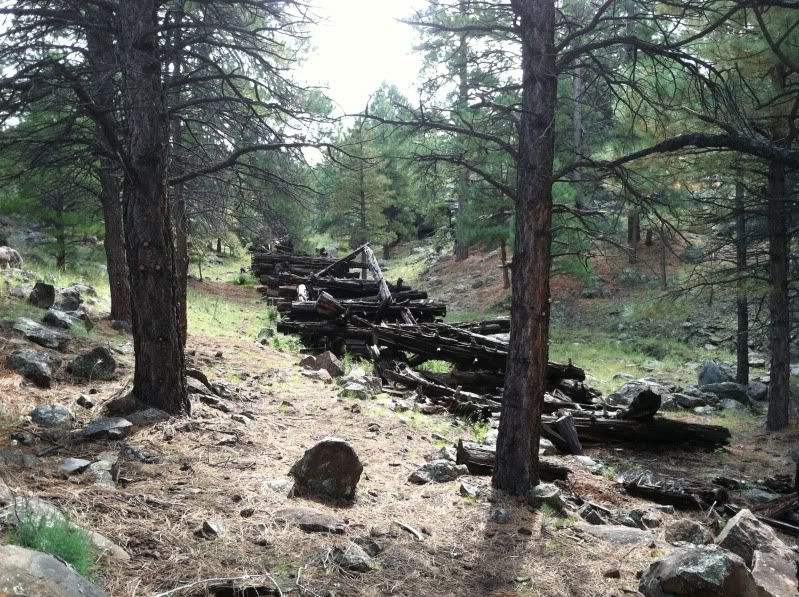
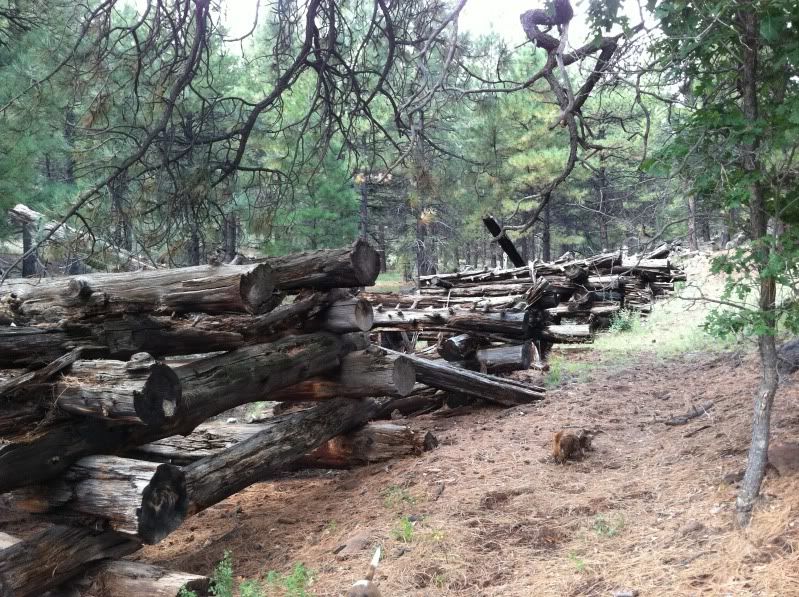
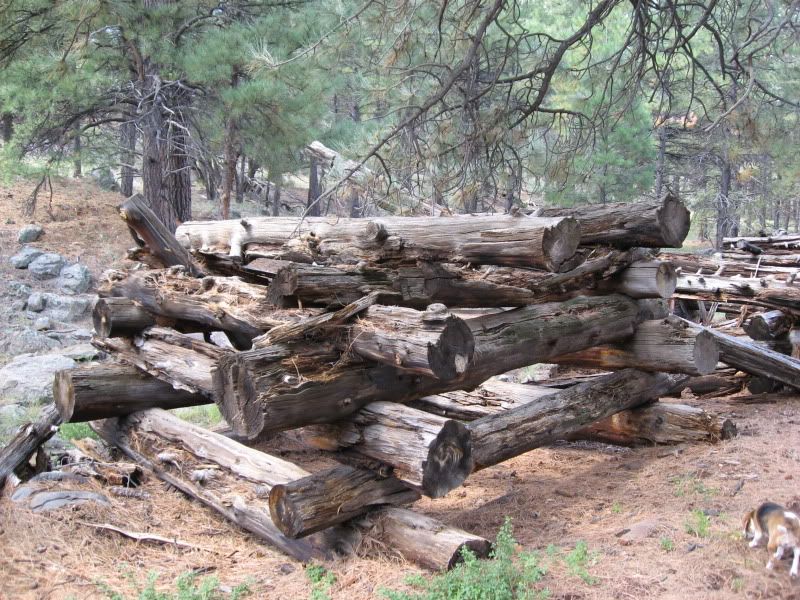
This trestle dates from 1901 and is located on a spur of what was the Saginaw-Manistee Lumber Company Bellemont line. It is located in the bottom of a very narrow drainage. The photo below shows the beginning of the drainage. The trestle begins just out of sight down the draw.
The total length is roughly 340'. Some of the logs are nearly 2' in diameter. Overall, it is a very impressive structure.
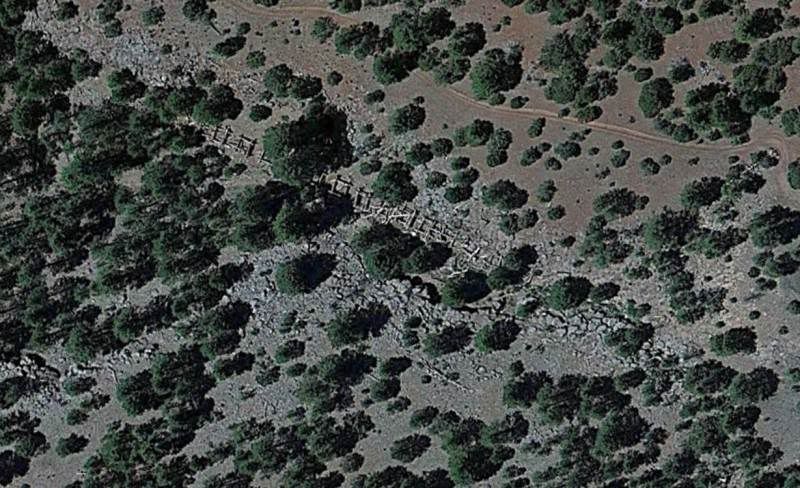
Here is a Google Earth screen capture.
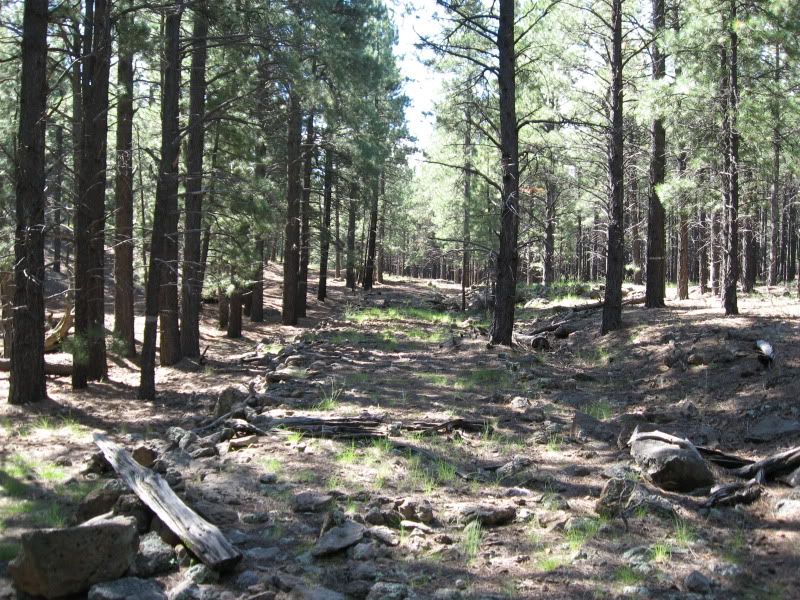
Here are a few pictures of the grade as it continues to the west and exits the drainage.
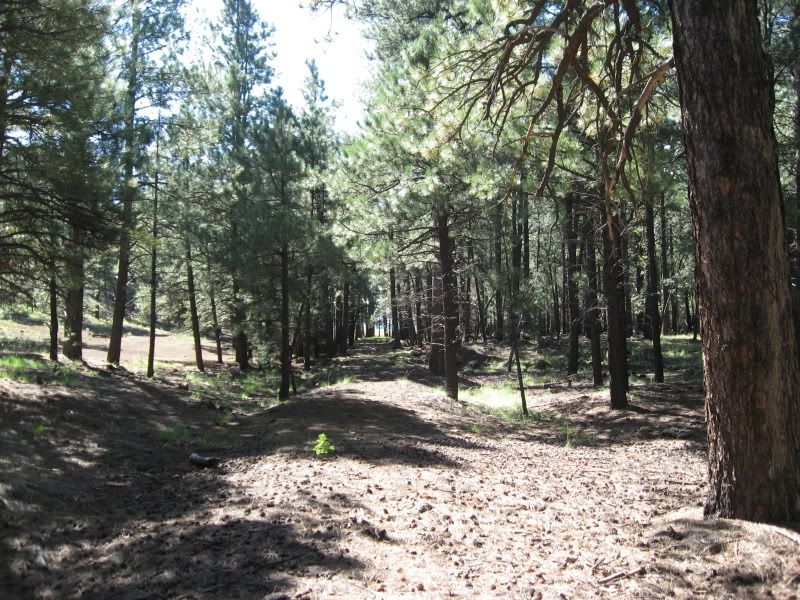
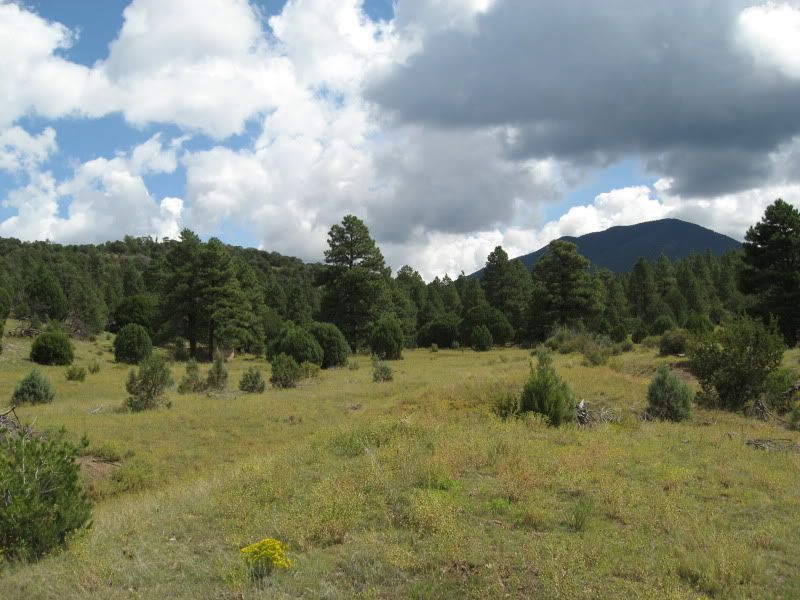
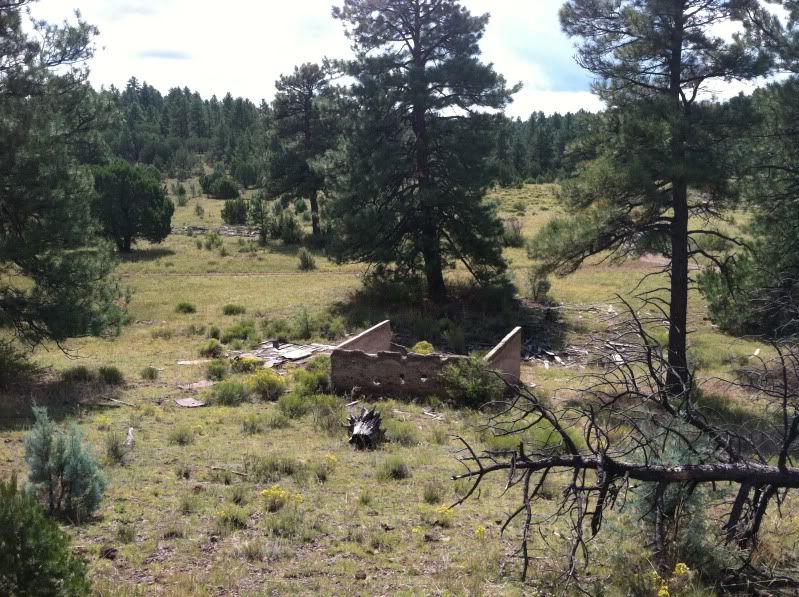
The grade eventually enters an open area where cabin remains and the ruins of a concrete building are located. I suspect this was one of the numerous logging camps operated by the Saginaw-Manistee company. The picture below is looking east back up the grade toward Sitgreaves Mountain.
Matt Riordan
Denis "Matt" Riordan was a truly "larger-than-life" individual who helped shape the early destiny of Flagstaff, Arizona. How Matt wound up in Flagstaff is a classic tale of The Old West. At the young age of 33, Matt was put in charge of the entire Navajo Reservation. During his short tenure in that position, his name came to the attention of Edward Everett Ayer who built the Flagstaff sawmill even before the railroad arrived in 1882. Ayer called Roirdan to Ayer's Chicago office and offered Matt a job as manager of Ayer's mill.
"Why, Mr. Ayer," Riordan replied, "I don't know any-
thing about the lumber business."
"Well, I'm blamed glad you don't. I've had all the experts
I want," was the emphatic rejoinder.
And the rest, as they say, is history. Before Matt left his position with the Navajo Reservation to go to Flagstaff, he wrote a blistering annual report. It's actually quite surprising that the report was published since it is some of the most utterly damning descriptions of the federal government's treatment of the Navajo.
We were fortunate to be able to find the full text of Matt's report. (The primary source links are located below the report.) The words here show the true heart and compassionate spirit of the legendary man who would play such a pivotal role in Flagstaff's early formative years.
This is the actual title of the report from which the above excerpts were taken:
United States. Office of Indian Affairs
Annual report of the commissioner of Indian affairs, for the year 1883
G.P.O., [1883]
v. : fold. maps ; 23 cm
Here is a link to the full report:
http://digital.library.wisc.edu/1711.dl/History.AnnRep83
Here is a link to the section of the report that includes Riordan's narrative.
http://images.library.wisc.edu/History/EFacs/CommRep/AnnRep83/reference/history.annrep83.i0018.pdf
We have created three Google Docs. The first includes the full text of Ayer's biography that describes Ayer's relationship with Riordan. It is located here:
https://docs.google.com/document/d/1AceuIkSnYMYph0Eh3nB9RhkHtdtGpRJr0iHDfX9jVAU/edit?usp=sharing
And here's a nice 16-page history of the Riordan Family.
http://archive.library.nau.edu/cdm/ref/collection/cpa/id/83484
Monday, April 11, 2016
Sedona Doesn't Exist
(Editor's Note: The following article appears in the online edition of "The Nevada County Scooper." We could find no Copyright notice on this article so we believe its reproduction here is within the "Fair Use" provisions of US Copyright law. The article is reproduced here in this format because its "native" format is on a website with a lot of objectionable material that our readers may find offensive or downright repulsive. We put the link to the original source at the bottom of this post.)
North San Juan, CA — North San Juan resident, part-time chemtrail researcher and amateur ionizing radiation hobbyist Skyy Wolford announced to a somewhat disinterested crowd out in front of the Sierra Super Stop that Sedona, Arizona is an elaborate hoax and does not exist. Mr. Wolford, who was recently in the news following his landmark Wi-Fi disability settlement, has been studying what he calls “the Sedona anomaly” for the past 3 years.
“There’s this thing I learned on the Internet called the Bielefeld effect,” said a mood-elevated Mr. Wolford in a Scooper telephone interview. “It’s where there’s this illusion that some place actually exists. People talk about it. They even claim to know people there. But it’s all fake. They’re either part of the conspiracy to keep the hoax alive, or they’re delusional. What’s even more interesting, is that this effect has become more pronounced after Hillary Clinton made a so-called ‘campaign stop’ in the fictitious spiritual town. Really interesting. Think about how far this conspiracy goes up the chain of command.”
The Bielefeld effect, also known as the Bielefeld conspiracy, spread in 1994 on the German Usenet, which claimed that the city of Bielefeld does not actually exist, but is an illusion propagated by various Illuminati forces. Originally an internet phenomenon, the effect has since spread to other hoax cities like Sedona, Arizona. To this day German Chancellor Angela Merkel, refers to Bielefeld in her speeches, even though the city doesn’t actually exist.
Sedona is supposedly located just north of Phoenix and has been called Arizona’s, and Earth’s for that matter, “spiritual vortex of the world” since the conspiracy was started over 117 years ago by landowners from around what is now known as Scottsdale. This is despite spiritualist Edgar Cayce’s proclamation that Nevada City, CA is indeed Earth’s primary vortex. However, after three attempts to contact the local government by the Nevada County Scooper with no success, Mr. Wolford’s observations seem less batshit crazy.
“Look,” continued Mr. Wolford,”It’s really simple to prove that Sedona doesn’t exist. All you have to do is answer these three questions. Number one. Do you know anyone from Sedona? Two. Have you ever been to Sedona, Arizona? And lastly, number three. Do you know anybody who has ever been to Sedona? And don’t say Hillary Clinton.”
The Scooper reached out to the local community and asked them Mr. Wolford’s three questions.
“Sedona is not a real town! Google it and you will find out for yourself! I actually lived in Cottonwood and drove to where Sedona was supposed to be,” said Christopher J. Rushin who currently lives in Grass Valley, “I’ve been ‘there,’ there’s nothing there but trees and houses and people and shit. No signs of civilization whatsoever. And even if there was such a place, Hillary Clinton would never go there. Y’all are kidding me, right?”
Others were more philosophical about the hoax, maintaining that they might have only dreamed about the city.
“I‘ve been to Sedona, and now that I think about it, it probably doesn’t actually exist,” commented Justin Anderson of Penn Valley, CA. “The place did seem too perfect, like a dream or something.”
Still others were a part of the conspiracy calling people who believe such things “stupid idiots.”
“I’m a truck driver. I live in Flagstaff, and I get many shipments into and out of Sedona,” said a Arizona truck driver Greg McKnight, a fact that bolsters his status as a Mossad/CIA operative. “As a matter of fact my wife grew up in the Sedona/Oak Creek area. So for you to even state Sedona doesn’t exist as a town or city whatever y’all want to call it, makes me believe you are an idiot. Or a troll. Or a Bernie Sanders supporter.”
As for Mr. Wolford, he gave the Scooper an old “I told you so.”
“Nice try,” continued Mr. Wolford. “You thought I was making this up, didn’t ya? Well now you know what I know. As soon as you ran into someone who was a Mossad operative, they immediately start calling you an idiot for calling out the Sedona hoax. But you get used to it after a while. Your skin gets tough with this thing I like to call ‘The Truth.'”
Here is the source link:
https://www.ncscooper.com/local-researcher-sedona-arizona-doesnt-exist/
Click at your own risk.
![]() |
| Skyy Wolford out in front of the Sierra Super Stop in North San Juan, CA. |
“There’s this thing I learned on the Internet called the Bielefeld effect,” said a mood-elevated Mr. Wolford in a Scooper telephone interview. “It’s where there’s this illusion that some place actually exists. People talk about it. They even claim to know people there. But it’s all fake. They’re either part of the conspiracy to keep the hoax alive, or they’re delusional. What’s even more interesting, is that this effect has become more pronounced after Hillary Clinton made a so-called ‘campaign stop’ in the fictitious spiritual town. Really interesting. Think about how far this conspiracy goes up the chain of command.”
The Bielefeld effect, also known as the Bielefeld conspiracy, spread in 1994 on the German Usenet, which claimed that the city of Bielefeld does not actually exist, but is an illusion propagated by various Illuminati forces. Originally an internet phenomenon, the effect has since spread to other hoax cities like Sedona, Arizona. To this day German Chancellor Angela Merkel, refers to Bielefeld in her speeches, even though the city doesn’t actually exist.
![]() |
| Here is a supposed postcard of Sedona, Arizona from 1900. However it is actually doctored. |
Sedona is supposedly located just north of Phoenix and has been called Arizona’s, and Earth’s for that matter, “spiritual vortex of the world” since the conspiracy was started over 117 years ago by landowners from around what is now known as Scottsdale. This is despite spiritualist Edgar Cayce’s proclamation that Nevada City, CA is indeed Earth’s primary vortex. However, after three attempts to contact the local government by the Nevada County Scooper with no success, Mr. Wolford’s observations seem less batshit crazy.
“Look,” continued Mr. Wolford,”It’s really simple to prove that Sedona doesn’t exist. All you have to do is answer these three questions. Number one. Do you know anyone from Sedona? Two. Have you ever been to Sedona, Arizona? And lastly, number three. Do you know anybody who has ever been to Sedona? And don’t say Hillary Clinton.”
The Scooper reached out to the local community and asked them Mr. Wolford’s three questions.
![]() |
| Christopher J. Rushin of Grass Valley, CA says there’s nothing but trees where Sedona, Arizona should be. |
Others were more philosophical about the hoax, maintaining that they might have only dreamed about the city.
“I‘ve been to Sedona, and now that I think about it, it probably doesn’t actually exist,” commented Justin Anderson of Penn Valley, CA. “The place did seem too perfect, like a dream or something.”
Still others were a part of the conspiracy calling people who believe such things “stupid idiots.”
![]() |
| Greg McKnight of Flagstaff, AZ thinks Skyy Wolford is a Bernie Sanders fan. |
As for Mr. Wolford, he gave the Scooper an old “I told you so.”
“Nice try,” continued Mr. Wolford. “You thought I was making this up, didn’t ya? Well now you know what I know. As soon as you ran into someone who was a Mossad operative, they immediately start calling you an idiot for calling out the Sedona hoax. But you get used to it after a while. Your skin gets tough with this thing I like to call ‘The Truth.'”
Here is the source link:
https://www.ncscooper.com/local-researcher-sedona-arizona-doesnt-exist/
Click at your own risk.
Posts deleted
All but one of the posts put up here over the past few years have been deleted.
This blog is in a "revision phase."
Wednesday, November 25, 2015
That Cut Throat Apache
![]() |
| The above photo was clipped from Page 24 of a 1965 program for the Flagstaff Pow Wow. However, this is precisely how Mormon Lake Lodge looked during my summer there in 1967. Look to the left above the VW and you can see the famous payphone "Mormon Lake #99". I never thought I'd find a photo like this! (Found 12/22/2019) Source: https://azmemory.azlibrary.gov/digital/collection/flgpow/id/10/ |
This is a story about That Cut Throat Apache. It has two endings. The first one is Happy. The second one is Sad. We will tell the first part here.
In the summers of 1966, 1967, and 1968, I worked for the US Bureau of Public Roads (BPR). Each early June, the government would pay for my flight from Indiana to San Francisco and put me up in a downtown hotel. I would report to 450 Golden Gate Avenue to work with the engineers for about a week. Then I would get sent to the Treasure Island supply depot for a few days. Finally, BPR would fly me off to some remote road project somewhere in the Far West.
When I showed up at BPR HQ in early June 1967, it wasn't long before the bosses let me know I was heading for The Happy Jack Project down in some God-forsaken remote corner of The Arizona Wilds. Practically within the first hour after I heard I was going to Happy Jack, the whispers began.
First an old engineer leaned across his drafting table into my wide eyes and said with a hushed voice, "You better watch out for that Cut Throat Apache down there. Don't ever turn your back on him or he will slit your throat."
And that's how it started. And that's how it continued. It didn't take long for everyone I worked with at 450 Golden Gate to tell me the same refrain. Even the old secretary chimed in the same frightening proclamation.
The litany kept up at Treasure Island were all the old rednecks worked. Boy, they really embellished the throat cutting part, often zipping a finger or steel rod across their throat while rolling their eyes and sticking out their tongue in a uniquely gruesome way.
By the time I boarded the airplane to Phoenix, I was truly spooked. And it didn't help matters when the tall guy with the flattop hair cut picked me up at Terminal 1 in Sky Harbor Airport. "You know about That Cut Throat Apache, right?" he barked as he helped with my luggage. My throat was already parched from the dry heat and I stammered "Yes, everyone has been warning me." To which he said, "Well, it's true. None of us know why or how he got hired but we all know never to turn our back on him. It's instinct with those savages--the second they see your back, their killer instinct comes out and they slit your throat. If you have to turn your back on him, make sure to get one of the crew to watch your back so he can't slit your throat."
They gave me a late 1950's Studebaker pickup truck to drive up Highway 87 to Clint's Well. From there, I turned left and slowly traversed the muddy, rutted, rotten excuse for a road to the Project Office at Happy Jack. BPR was transforming the basalt-studded two-track into a first class road now know to untold thousands of people as Forest Highway 3.
It was going to be my job that summer to join the BPR crew and do whatever they told me to do. Naturally, I was on edge and very apprehensive as I pulled into a cinder covered parking spot in front of the Project Office. I was even more alarmed to see a dark-faced, black-haired, swarthy, short Indian standing outside the project trailer eyeing me as he leaned up against the project trailer.
My heart pounded as I got out of that truck and I didn't take my eyes off that Indian for a second. I locked the truck and quickly entered the project trailer with my transfer and assignment papers. I had absolutely no clue what was next. I had no idea where I could be quartered...nothing. Luckily, the Project Engineer (PE) was great guy...very welcoming and very laid back compared to some of them I knew. He told me they had arranged for a log cabin for me up at Mormon Lake Lodge. It would be $30 a month and they had already advanced me the first $30. All I had to do was drive up there and check in with Gail Wingfield at the Lodge and he would show me the ropes. The PE then told me all about the work schedule and when to report the next day and so forth. And then he narrowed his eyes and said, "And you're going to be working with Sid Tortice--that Apache standing outside. You've heard about him, right?"
My eyes widened and I practically gulped and simply said, "Yes." To which the PE looked away and replied, "Well, good, don't forget what you've been told."
I went back out and almost leaped into the Studebaker and started bumping my slow speed way the many miles up the wrecked road to Mormon Lake. Gail Wingfield was the personification of The True Western Gentleman. He could have been John Wayne's brother. Even to this day, I've never met anyone as True West as Gail. He was The Best of The Best in every way. Gail took me right under his welcoming wing and gave me The Grand Tour of Mormon Lake Lodge and its various amenities, such as they were in the Summer of 1967. He was especially proud of the one payphone booth outside--Mormon Lake #99, he said with great pride.
![]() |
| My cabin was the one on the left in this photo by Burton Frasher. Colorization by Br'er Lar. |
As he showed me my small log cabin, Gail said, "You see this other bunk?" I nodded. Gail added, "Well, you're free to find a room mate and the rent will stay the same. It could save your $15 a month. The choice is yours."
I Thanked Gail with the fresh enthusiasm of a teenage Hoosier. Gail simply tipped his hat and strode from the cabin to resume his Major Domo Duties as King of Mormon Lake.
The next day dawned way, way too early but, luckily, I was up and full of energy and made it back to Happy Jack well before the 7:30 AM reporting time. The PE assigned each of us our daily duties and then said, "Sid, show John the ropes." Oh, my Gosh, my heart almost stopped. Somehow my Midwestern Mind thought I was about to get lynched.
But, no, it didn't happen that way. Sid Tortice walked up to me, took off his hat, looked squarely into my eyes and said, "Hello, John, my name is Sid Tortice." He put out his hand and, of course, there was no way I could decline shaking his hand. He had an uncommonly vice tight grip for a Native American. As he shook my hand, he continued looking into my eyes in an eerily unsettling way. He did not smile.
Sid and I climbed into that Studebaker and started bouncing our way over basalts to whatever sector we had been assigned to work that day. Sid said nothing. Of course, I said nothing either. We just drove and looked out the windshield. But I do have to admit I kept my peripheral vision locked on Sid as we drove that morning.
It was not uncommon in that project to drive 30-60 minutes before arriving at your work site for the day. As chance wold have it, the PE has given me the toughtest duty of the project for my first day. They routinely gave Sid the toughest duty EVERY day so they thought they'd have some fun throwing the Midwest kid's feet into the fire with That Cut Throat Apache.
We were to work together as "Guinea Hoppers" that day. Guinea's were very small wooden stakes pounded into the road grade by project survey crews. Each Guinea had a blue top colored blue with a kind of crayon. The stakes themselves were known as "Blue Tops" by the Contractor's grading crew.
However, in the ebb and flow of construction, the Blue Tops would get covered with cinders and become invisible. That's when and where The Guinea Hoppers came into play. Your job was to literally run in front of the road grader with a short-handled axes to find and uncover the Blue Tops before getting run over by the grader. It was hot, highly-stressful, intense work that required constant focus. And it was impossible for one man to do it all day. That's why Guinea Hoppers worked in pairs. We played tag team with each other.
When one of us would practically fall down and puke from the stress, the other one would pick up the axe and run with it. It was easily the most grueling physical job I ever did in this lifetime. Sid went to the grader operator and told him that I was new to the game and asked him to cut us some slack that day. The grader operator nodded and was a very gentle man.
I couldn't believe how hard Sid was working. Once we got to working together, the thought of worrying about turning my back on Sid never entered my mind. Sid HAD MY BACK! When the grader would get to close to me, he would motion for the operator to slow down. Sid saved my bacon that day, as he would come to do on so many other days that summer.
I don't remember how many hundreds or thousands of feet of Blue Tops we covered that day but it was a helluva lot. At the end of the day, Sid and I were totally covered in sweat and cinder dust and just completely winded. We both climbed back into the Studebaker for the long drive back to Happy Jack, watching the ponderosa forest pass before our eyes. Neither one of us said a word on that drive back. When we pulled in front of the Project Trailer, Sid turned to me and looekd me in the eyes and said, "John, You did good today. I am happy to work with you." And Sid got out and went his own way.
I checked in and out and drove back to Mormon Lake shaking my head and trying to digest what had happened to me that day. But the next day dawned the same and it was a lot like the movie Ground Hog Day. But with each passing day, the divide between me and Sid dwindled It didn't take long to realize I was working with a True Human, a Man I could respect. And it didn't take long for me to ask Sid if he'd like to be my room mate. He smiled so wide when I asked him that and moved right in that night.
We became Best Friends Forever. Our summer together is one of my Best Memories. Sid was one of the Kindest, Most Wonderful Human Beings I have ever met. And he was a wise teacher as well. He took me under his wing and pointed out so many unknown ways of the world to me, With each passing week, my respect and affection for Sid grew by leaps and bounds. We became brothers that summer and we each enjoyed each other's company so much. Sid never tired of hearing my boyhood stories from Indiana. And, of course, I never tired of hearing him tell about hunting for Acorns near Carrizo or the rituals of becoming a man in The White Mountain Apache Tribe.
One of the crew has a brand new yellow 1967 Mustang convertible. We would buy cheap beer in Flagstaff and drive all weekend long around The Coconino Plateau. Sid would sit in the back seat, running his fingers through his long waving black hair. With a beer in one hand and his hair in the other, he would yell out into space, "My Land! My Trees! My Cattle! My Water!" And we would drive on, listening to The Beatles on Bill's 8-track tape player in the Mustang.
As my 1967 Season drew to a close there in Mormon Lake, I finally decided on my last night to tell Sid about the The Cut Throat Apache Story. At first, Sid laughed his great and awesome Apache Laugh. But then he became very serious and told me stories of all the prejudice he had grown up with in his life. He said he suspected I had been told to dislike and distrust him. And then he told me that he recognized I was a "True Human Being" when I drove up to the Project Office and that we could become Friends.
We hugged together that night and high-fived and had such a great last night amid the tall pine trees.
It was a wonderful Happy Ending to my Summer with That Cut Throat Apache!
Subscribe to:
Posts (Atom)